

Aerial Bundle Cable Specification plays a critical role in modern power distribution, ensuring safety, reliability, and efficiency across urban and rural electrical networks. Unlike traditional bare conductors, aerial bundle cables (ABC) are fully insulated and supported by a messenger wire, reducing the risk of short circuits, power theft, and accidental contact. These cables are widely used in low voltage (LV) and medium voltage (MV) overhead lines, industrial installations, street lighting, and service drops, making them a versatile choice for utilities, contractors, and industrial clients worldwide.
The design and construction of ABC cables are guided by international standards such as IEC 60502 and ASTM, which specify conductor materials, insulation types, voltage ratings, and performance requirements. Aluminum and aluminum alloy conductors with XLPE insulation are commonly used to ensure durability, UV resistance, and mechanical strength. By carefully selecting the right ABC cable specification, engineers can optimize current-carrying capacity, minimize voltage drop, and ensure long-term reliability in challenging environmental conditions.
Aerial Bundle Cable Specification: Technical Standards for Modern Power Distribution
Aerial Bundle Cables (ABC) have become a cornerstone in modern power distribution networks, providing safer, more reliable, and efficient solutions for both urban and rural applications. HNBF Power, a trusted manufacturer of ABC cables and bare conductors, delivers high-quality solutions that comply with international standards and meet the growing demands of utilities, contractors, and industrial clients worldwide.
In this guide, we will explain all aspects of aerial bundle cable specifications, including technical standards, construction, types, applications, and installation considerations.
Aerial Bundle Cables (ABC)
An Aerial Bundle Cable (ABC) is an overhead power distribution cable system where insulated conductors are bundled together and supported by a messenger wire. Unlike bare overhead conductors, ABC cables are insulated, which reduces power losses, enhances safety, and minimizes outages caused by short circuits or accidental contact.
Applications:
- Urban and rural electricity distribution
- Industrial power supply lines
- Service drops for residential and commercial buildings
Case study: In multiple rural electrification projects in South America, replacing bare conductors with LV ABC cables reduced outages by 40% and significantly decreased maintenance costs over three years.
Key Features of Aerial Bundle Cables (ABC)
ABC cables combine electrical performance with mechanical strength. The main features include:
- Safety and Insulation: Fully insulated conductors reduce the risk of electrical shock to humans and animals.
- Durability: Designed to withstand UV exposure, harsh weather, and mechanical stress.
- Reduced Power Theft: The insulation prevents tapping, reducing theft and energy loss.
- Installation Efficiency: Multiple conductors bundled together simplify installation and reduce pole requirements.
Example: In urban networks in India, ABC cable deployment reduced power theft incidents by over 25% compared to conventional bare conductors.
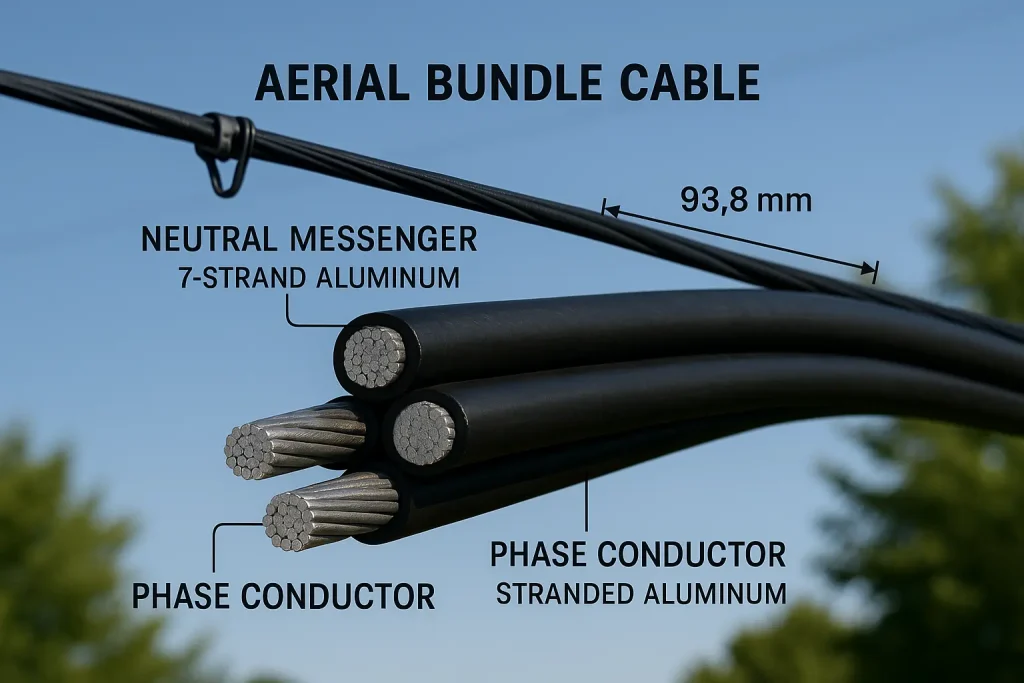
Aerial Bundle Cable Specification: Complete Overview
ABC cables are manufactured according to international standards to ensure reliability, performance, and safety. The primary specifications include:
- Voltage Classes: LV (0.6/1kV) and MV (6kV–35kV)
- Conductor Material: Aluminum or AAAC (All Aluminum Alloy Conductor)
- Insulation Material: XLPE (cross-linked polyethylene) with UV resistance
- Standards Compliance: IEC 60502, ASTM B231/B232, ISO 9001
- Environmental Performance: Weatherproof, corrosion-resistant, flame-retardant
Case Example: HNBF Power supplied LV ABC cables for a large-scale urban project in Africa, ensuring compliance with IEC standards, which enabled seamless integration into existing networks.
Low Voltage ABC Cable Specifications (LV ABC)
LV ABC cables are designed for distribution voltages of 0.6/1kV and are commonly used for residential and small commercial networks.
Technical Details:
- Conductor: Stranded aluminum
- Insulation: XLPE, 1.2–2 mm thickness
- Core Configurations: Single, duplex, triplex, quadruplex
- Applications: Overhead distribution in urban streets, service drops, street lighting
Case Example: A European utility replaced conventional bare lines with LV ABC cables, resulting in a 20% reduction in maintenance costs due to enhanced insulation and weather resistance.
Medium Voltage ABC Cable Specifications (MV ABC)
MV ABC cables operate at 6kV to 35kV and are suitable for industrial areas, long-span distribution lines, and secondary substations.
Key Specifications:
- Phase Conductors: Stranded aluminum or AAAC
- Insulation: XLPE with additional insulation for phase separation
- Shielding: Semi-conductive tape or shield for MV lines
- Current Rating: Typically 100–600 A depending on cross-section and installation conditions
- Operating Temperature: Maximum conductor temperature 90–120°C
Example: HNBF Power supplied MV ABC cables for a mining facility, ensuring reliable power distribution over 10 km of overhead lines in harsh environmental conditions.
ABC Cable Construction Details
Understanding ABC cable construction is crucial for design and specification. Key components include:
- Phase Conductor: Stranded aluminum or AAAC for conductivity and flexibility
- Messenger Wire: Provides mechanical support; can be bare or insulated
- XLPE Insulation: Offers UV and weather resistance
- Sheath Options: Flame-retardant, anti-aging, and anti-corrosion coatings for high durability
Practical Insight: Choosing the correct combination of conductor size and insulation thickness ensures minimal voltage drop and maximum safety.
ABC Cable Construction Table (Technical Data Summary)
| Parameter | LV ABC | MV ABC | Notes |
|---|---|---|---|
| Conductor Material | Aluminum | Aluminum / AAAC | Stranded for flexibility |
| Cross Section | 16–95 mm² | 25–150 mm² | Based on current load |
| Insulation Thickness | 1.2–2 mm | 2–5 mm | XLPE, UV-resistant |
| Messenger Wire | 10–20 mm² | 16–50 mm² | Bare or insulated |
| Voltage Rating | 0.6/1 kV | 6–35 kV | IEC/ASTM standards |
| Ampacity | 50–400 A | 100–600 A | Depends on installation |
This table helps engineers quickly compare ABC cable options and select appropriate types for specific applications.
Types of Aerial Bundled Cables
- Single-core LV ABC: For small overhead networks and service drops
- Duplex/Triplex/Quadruplex LV ABC: Residential or commercial distribution
- MV ABC: Insulated, semi-conductive, for long-distance overhead lines
- Messenger-supported ABC: Provides mechanical support for long spans
Example: Triplex ABC cables are widely used in urban areas to reduce pole clutter and simplify installation.
Performance Requirements and Quality Testing
To ensure reliability, ABC cables undergo rigorous tests:
- Mechanical Strength: Tensile tests for conductor and messenger wires
- Electrical Performance: Insulation resistance, voltage withstand tests
- Environmental Resistance: UV, temperature cycling, moisture resistance
- Flame Retardancy & Anti-aging: For safety in overhead lines
Case Example: HNBF Power maintains in-house testing labs to simulate environmental conditions, ensuring long-term durability of ABC cables before shipment.
How to Specify ABC for Overhead Line Power Distribution
Specifying ABC cables requires consideration of:
- Voltage Level: LV or MV depending on distribution needs
- Conductor Size: Based on load and span length
- Messenger Wire Type: Bare for cost efficiency, insulated for higher safety
- Environmental Conditions: Coastal, high-UV, or industrial areas
- Installation Parameters: Sag, pole spacing, and tension
Practical Tip: Always check IEC/ASTM standards and confirm with a certified manufacturer like HNBF Power for customized solutions.
Applications of LV and MV Aerial Bundle Cables
- Urban distribution networks
- Rural electrification
- Street lighting
- Industrial overhead power lines
- Service drops for residential & commercial buildings
Example: In India, ABC cables have replaced bare conductors in urban streets, improving reliability and reducing outages caused by trees or accidental contact.
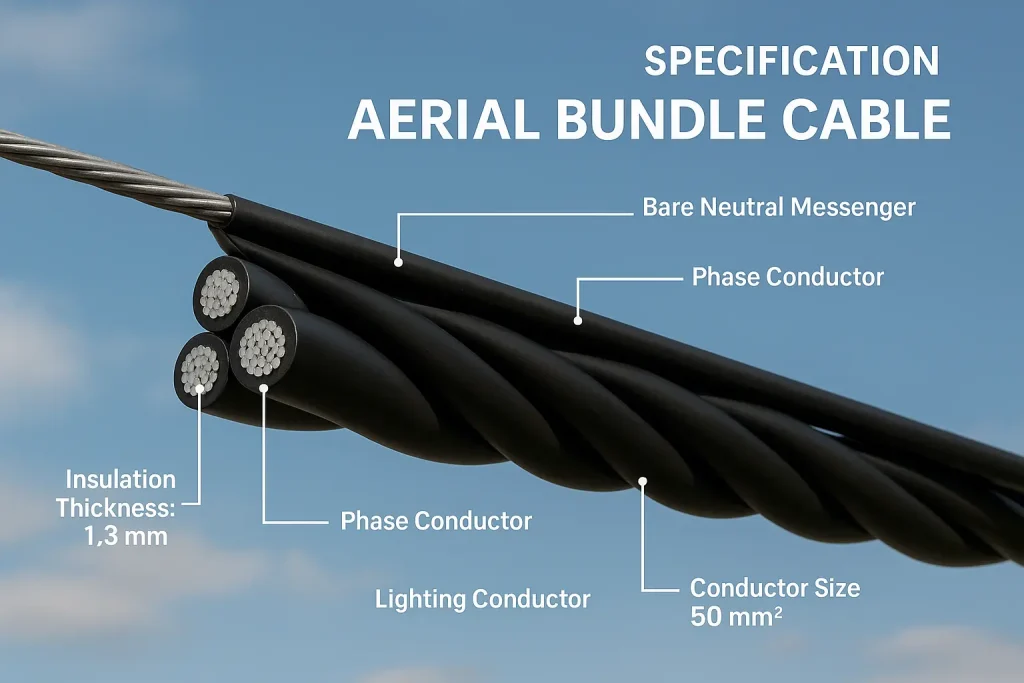
Installation Guidelines for ABC Cables
- Maintain clearances from trees, buildings, and roads
- Proper pole spacing to avoid excessive sag
- Sag & tension calculations to prevent conductor breakage
- Safe jointing and termination practices to avoid faults
Installation guidelines ensure both electrical performance and safety.
Benefits of Using ABC Cable in Modern Power Networks
- Enhanced safety for humans and animals
- Reduced maintenance and fault incidents
- Lower installation costs due to fewer poles
- Theft prevention and improved voltage regulation
- Reliable performance in urban and rural networks
Example: Utilities in South America reported a 30% reduction in outage-related complaints after switching to ABC cables.
Common Questions When Reviewing ABC Specifications
- How to interpret datasheets
- Difference between insulated and bare messenger wires
- Best ABC cable types for harsh or coastal environments
- Current ratings and temperature limits
Providing this clarity helps engineers make informed decisions quickly.
Why Choose HNBF Power for ABC Cable Manufacturing
- Manufacturing Capacity: Large-scale production for LV and MV ABC cables
- Compliance: IEC, ASTM, ISO 9001 certified products
- Custom Specifications: Tailored ABC solutions for specific utility or industrial needs
- Global Export: Supplying 100+ countries with proven track record
- Testing & Quality Assurance: In-house labs and factory-controlled quality processes
HNBF Power stands as a trusted supplier for utilities, contractors, and industrial clients.
FAQ – Aerial Bundle Cable Specification
Q1: What is an Aerial Bundle Cable (ABC)?
A: An ABC cable is an insulated overhead power distribution cable where multiple conductors are bundled together and supported by a messenger wire. It reduces power theft, improves safety, and enhances reliability in urban and rural electrical networks.
Q2: What are the voltage ratings for ABC cables?
A: ABC cables come in Low Voltage (0.6/1 kV) for residential/commercial use and Medium Voltage (6–35 kV) for industrial and long-distance overhead lines.
Q3: What materials are used in ABC cable construction?
A: Phase conductors are typically stranded aluminum or aluminum alloy (AAAC). Insulation is XLPE, which is UV and weather-resistant, while the messenger wire can be bare or insulated steel/aluminum.
Q4: What are the advantages of using ABC cables?
A: ABC cables offer enhanced safety, reduced power theft, improved network reliability, fewer poles, and simplified installation for overhead distribution systems.
Q5: How is ABC cable different from traditional bare conductors?
A: ABC cables are insulated, reducing short circuits and outages, whereas bare conductors are uninsulated and more prone to faults, especially in urban or vegetated areas.
Q6: How to choose the right ABC cable specification?
A: Consider voltage class (LV or MV), conductor size, insulation thickness, messenger type, environmental conditions, and span length. Always follow IEC/ASTM standards and consult manufacturers like HNBF Power.
Q7: What types of ABC cables are available?
A: Common types include Single-core LV ABC, Duplex/Triplex/Quadruplex LV ABC, Medium Voltage insulated ABC, and Messenger-supported ABC for long spans.
Q8: What quality tests are performed on ABC cables?
A: ABC cables undergo mechanical strength tests, insulation resistance checks, flame-retardant tests, UV/weathering resistance assessments, and electrical performance evaluations.
Q9: Where are ABC cables commonly used?
A: Applications include urban and rural distribution networks, industrial overhead lines, street lighting systems, and service drops for residential and commercial buildings.
Q10: Why choose HNBF Power for ABC cables?
A: HNBF Power offers IEC/ASTM-compliant LV and MV ABC cables, in-house testing labs, custom specifications, large-scale manufacturing, and global export experience for reliable power distribution solutions
Selecting the right ABC cable involves balancing voltage class, conductor size, insulation type, environmental factors, and installation requirements.
HNBF Power provides high-quality, certified LV and MV ABC cables that ensure reliability, safety, and long-term performance in modern power distribution networks.